
Landfills play a crucial role in modern waste management systems, providing a controlled and organized way to handle the disposal of solid waste. However, improper landfill management can lead to severe environmental hazards, such as groundwater contamination, methane emissions, and soil degradation. Geomembrane sheets have become indispensable in landfill construction, serving as a protective barrier that prevents these risks and ensures sustainable waste containment. Here’s a closer look at the role of geomembrane sheets in landfill construction and why they are a cornerstone of environmentally responsible waste management.
1. Base Lining for Waste Containment
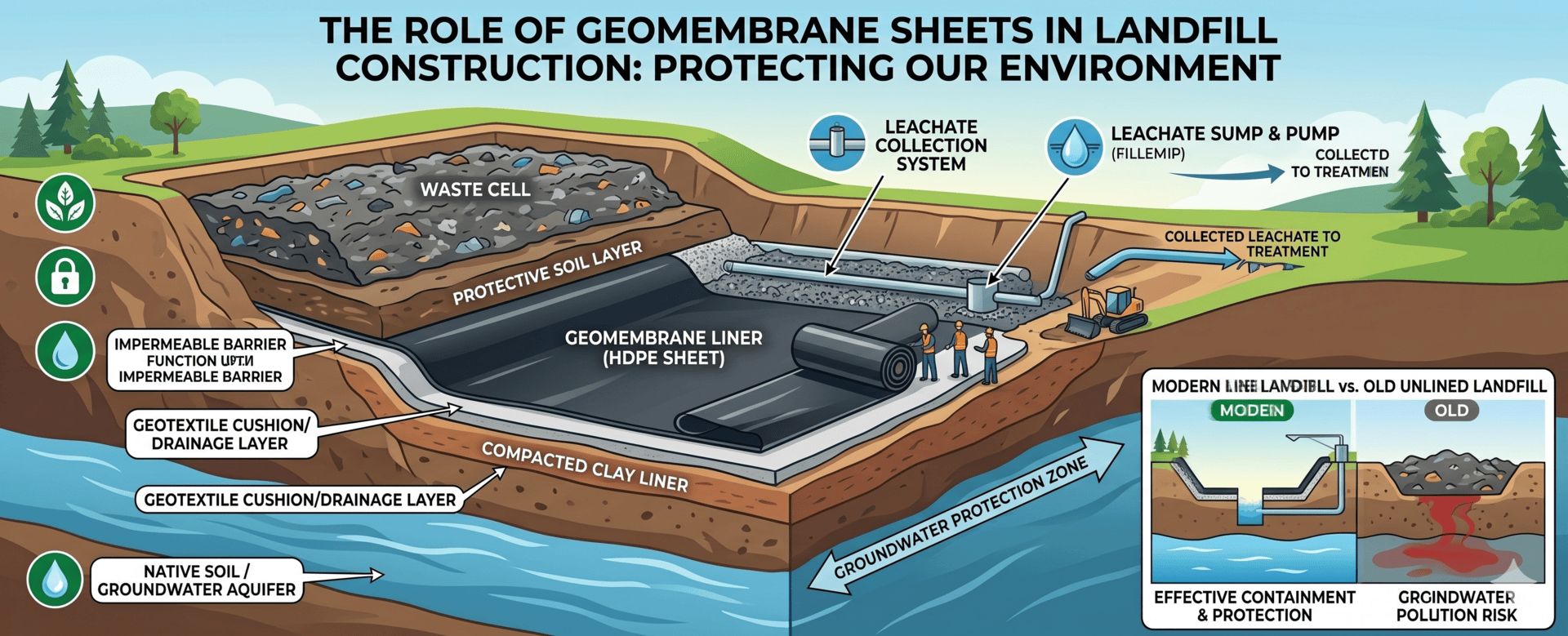
The most critical function of geomembrane sheets in landfill construction is as a base liner. These impermeable sheets, often made of HDPE (High-Density Polyethylene), create a barrier between the landfill contents and the surrounding environment. This prevents leachate—an acidic and toxic liquid formed when waste decomposes—from seeping into the soil and contaminating groundwater sources.
The use of geomembrane sheets ensures that harmful substances are confined within the landfill, reducing the risk of environmental pollution. When combined with geotextiles, which provide additional filtration, the liner system becomes even more robust.
2. Cap Liners for Landfill Closure
At the end of a landfill’s operational life, it must be capped to prevent further environmental harm. Geomembrane sheets are used as part of the capping system to seal off the landfill. These caps prevent rainwater from entering the landfill, thereby minimizing the formation of leachate.
Additionally, geomembrane caps help trap and control the release of landfill gases, such as methane and carbon dioxide, which are byproducts of organic waste decomposition. By containing these gases, geomembranes reduce the risk of air pollution and make it possible to capture and utilize the gases as a renewable energy source.
3. Preventing Groundwater Contamination
Groundwater contamination is one of the most significant risks associated with landfills. Without proper containment systems, toxic leachate can infiltrate the water table, leading to severe health and environmental consequences. Geomembrane sheets act as a dependable protective layer, preventing any contact between the landfill waste and groundwater.
This protection is particularly crucial in areas with a high water table or regions prone to heavy rainfall, where the risk of contamination is greater. By integrating geomembranes into landfill construction, authorities can ensure the safety of surrounding water resources and ecosystems.
4. Supporting Gas Management Systems
Landfill gas, primarily composed of methane and carbon dioxide, is a significant contributor to greenhouse gas emissions. Geomembrane sheets are essential for creating gas management systems within landfills. These systems collect, channel, and contain the gases produced during waste decomposition.
The impermeable nature of geomembranes ensures that landfill gases do not escape into the atmosphere uncontrollably. Instead, they are captured and either flared off safely or converted into energy through landfill gas-to-energy systems, contributing to sustainable energy production.
5. Erosion Control and Slope Stabilization
Landfill sites often have steep slopes to maximize space for waste containment. These slopes are prone to erosion, especially during heavy rainfall. Geomembrane sheets, used in conjunction with geotextiles and other materials, help stabilize these slopes and prevent erosion.
By providing a protective layer over the landfill surface, geomembranes maintain the structural integrity of the landfill, ensuring that waste remains securely contained even in adverse weather conditions.