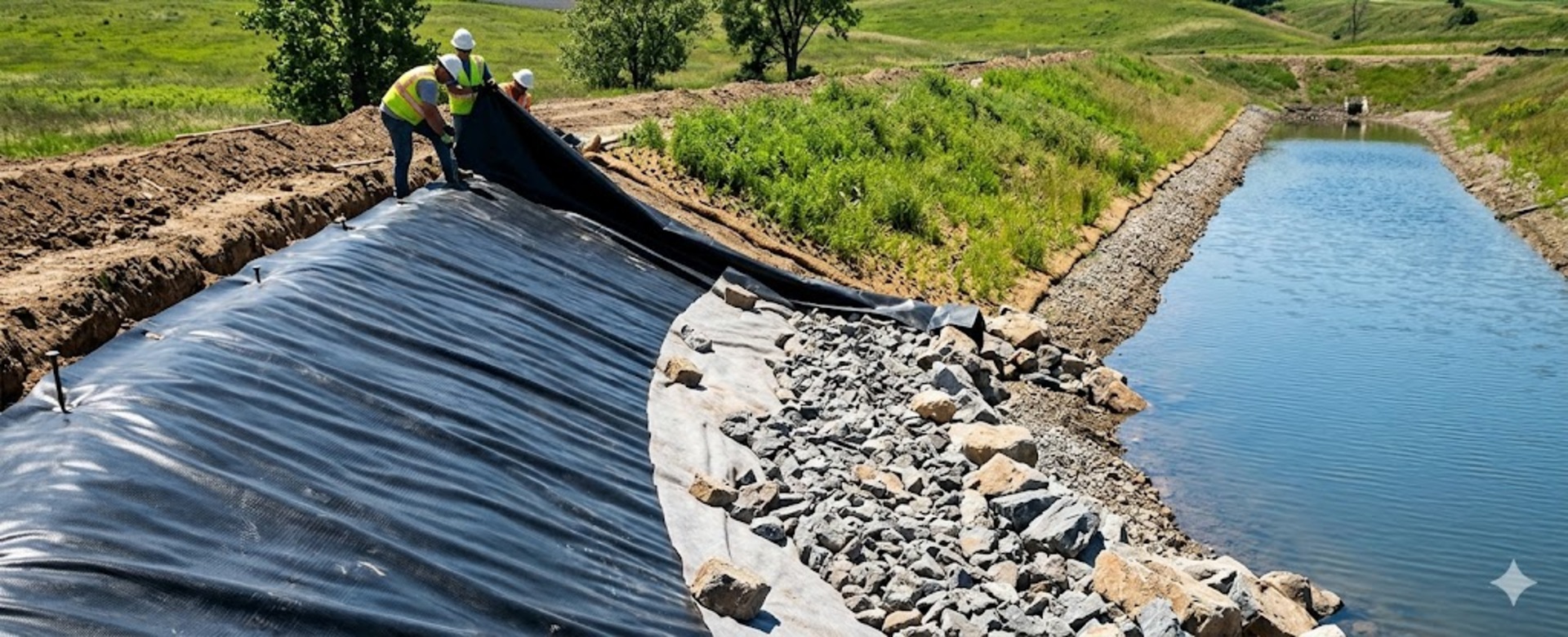

Erosion is a significant environmental challenge, leading to soil degradation, water quality issues, and damage to infrastructure. Pond liners play a critical role in erosion control by stabilizing soil and water systems, protecting landscapes, and ensuring long-term structural integrity.
How Pond Liners Help Control Erosion:
- Stabilizing Slopes and Banks:
- Pond liners provide a protective barrier that stabilizes the soil on slopes and embankments, preventing erosion caused by water flow or heavy rainfall.
- Applications: Irrigation canals, reservoirs, and stormwater retention ponds.
- Preventing Sediment Runoff:
- Liners prevent soil particles from entering water bodies, reducing sediment runoff and maintaining water clarity.
- Applications: Decorative ponds, wetlands, and agricultural reservoirs.
- Protecting Shorelines:
- Liners are used along pond edges to prevent wave action and water currents from eroding the shoreline.
- Applications: Recreational ponds and aquaculture systems.
- Reducing Soil Displacement in Flow Channels:
- By lining water channels and streams, pond liners prevent the erosion of the channel bed and banks, maintaining the waterway’s shape and flow.
- Applications: Drainage channels and flood mitigation projects.
- Facilitating Vegetation Growth:
- When combined with geotextiles or soil layers, liners support vegetation growth, enhancing natural erosion control and improving habitat stability.
- Applications: Constructed wetlands and bioengineered slopes.
Benefits of Using Pond Liners for Erosion Control:
- Durability: Resists water pressure, wave action, and weather fluctuations.
- Cost-Effectiveness: Reduces the need for frequent maintenance or regrading.
- Environmental Protection: Prevents sedimentation and preserves ecosystems.
By integrating pond liners into erosion control strategies, projects can achieve long-term stability and sustainability while minimizing environmental impact.