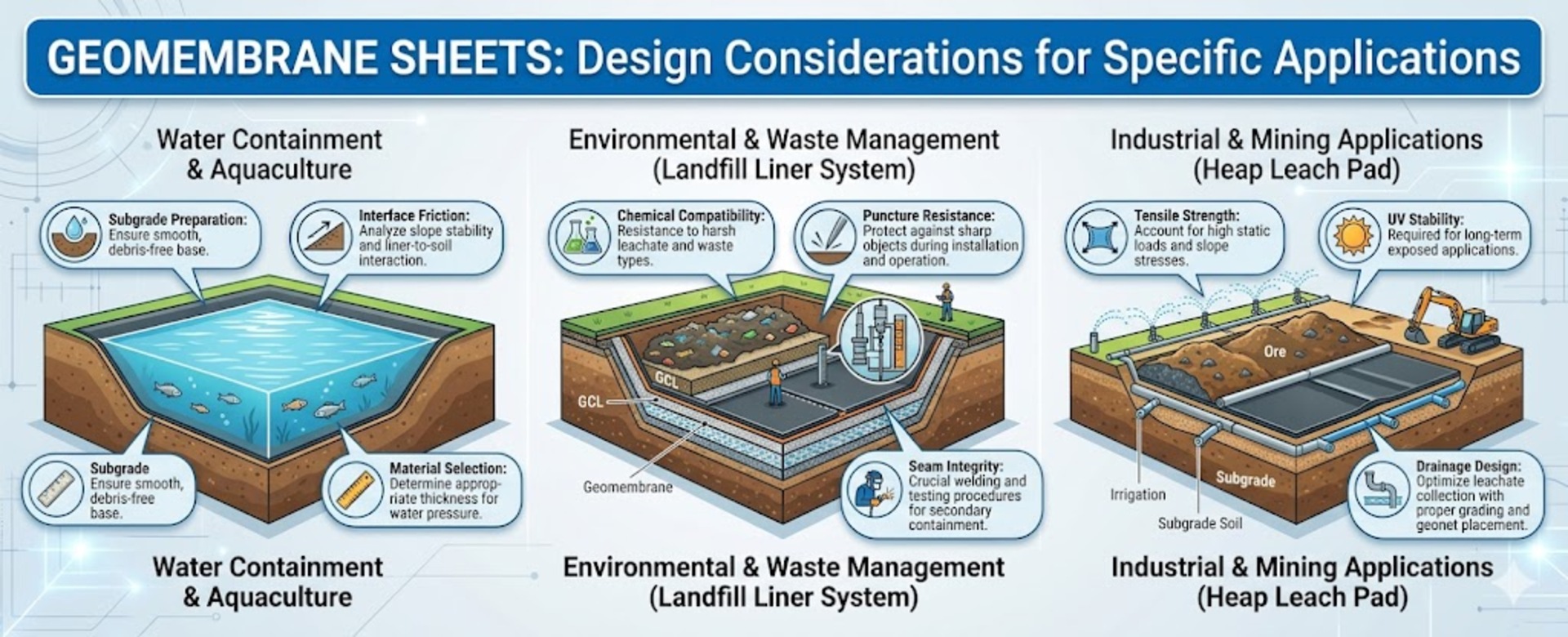

When designing systems that involve the use of geomembrane sheets, several factors must be taken into account to ensure optimal performance. The application, environmental conditions, and desired outcomes will all influence the design process, requiring careful consideration of materials, thickness, installation methods, and protective layers.
Key Design Considerations:
- Material Selection Based on Application
The choice of material for the geomembrane is critical to the success of the project. For applications that involve the containment of hazardous waste, materials like HDPE are preferred due to their chemical resistance and durability. For less demanding applications, such as pond liners or landscape barriers, PVC or LDPE may be more appropriate. The material should be selected based on its resistance to UV, temperature extremes, chemical exposure, and mechanical stresses. - Thickness of the Geomembrane
The thickness of the geomembrane influences its strength and durability. Thicker geomembranes offer higher resistance to punctures and tears but can be more challenging to handle and install. For applications such as landfills, where additional protection is needed, thicker geomembranes may be required. Conversely, for less demanding applications, thinner geomembranes may be sufficient, offering cost savings without sacrificing performance. - Seam and Joint Design
The integrity of seams and joints is vital to the performance of the geomembrane system. Proper welding techniques should be used to ensure a strong, leak-proof seal. Common methods include thermal welding, extrusion welding, and adhesive bonding. The design of seams should also consider environmental factors like temperature and humidity, as these can affect the quality of the weld. - Subgrade Preparation
The subgrade must be adequately prepared to support the geomembrane. It should be smooth, free of sharp objects, and compacted to prevent punctures and tears. Any irregularities in the subgrade, such as sharp rocks or debris, should be removed or mitigated before geomembrane installation. - Environmental and Load Considerations
The design must account for environmental factors such as temperature fluctuations, UV exposure, rainfall, and wind. In applications where geomembranes will be exposed to significant mechanical stress or heavy loads, the design should incorporate reinforcement or thicker geomembrane materials to ensure long-term durability. - Access to Monitoring and Maintenance
Designing the system with ease of monitoring and maintenance in mind is essential for the longevity of the geomembrane. For large-scale projects like landfills or mining operations, access points should be incorporated to allow for routine inspections and repairs. Installation of leak detection systems can also be included as part of the design to ensure early detection of potential failures.
By carefully considering these design factors, engineers and project managers can ensure that the geomembrane sheets perform effectively and provide long-lasting protection for the intended application.