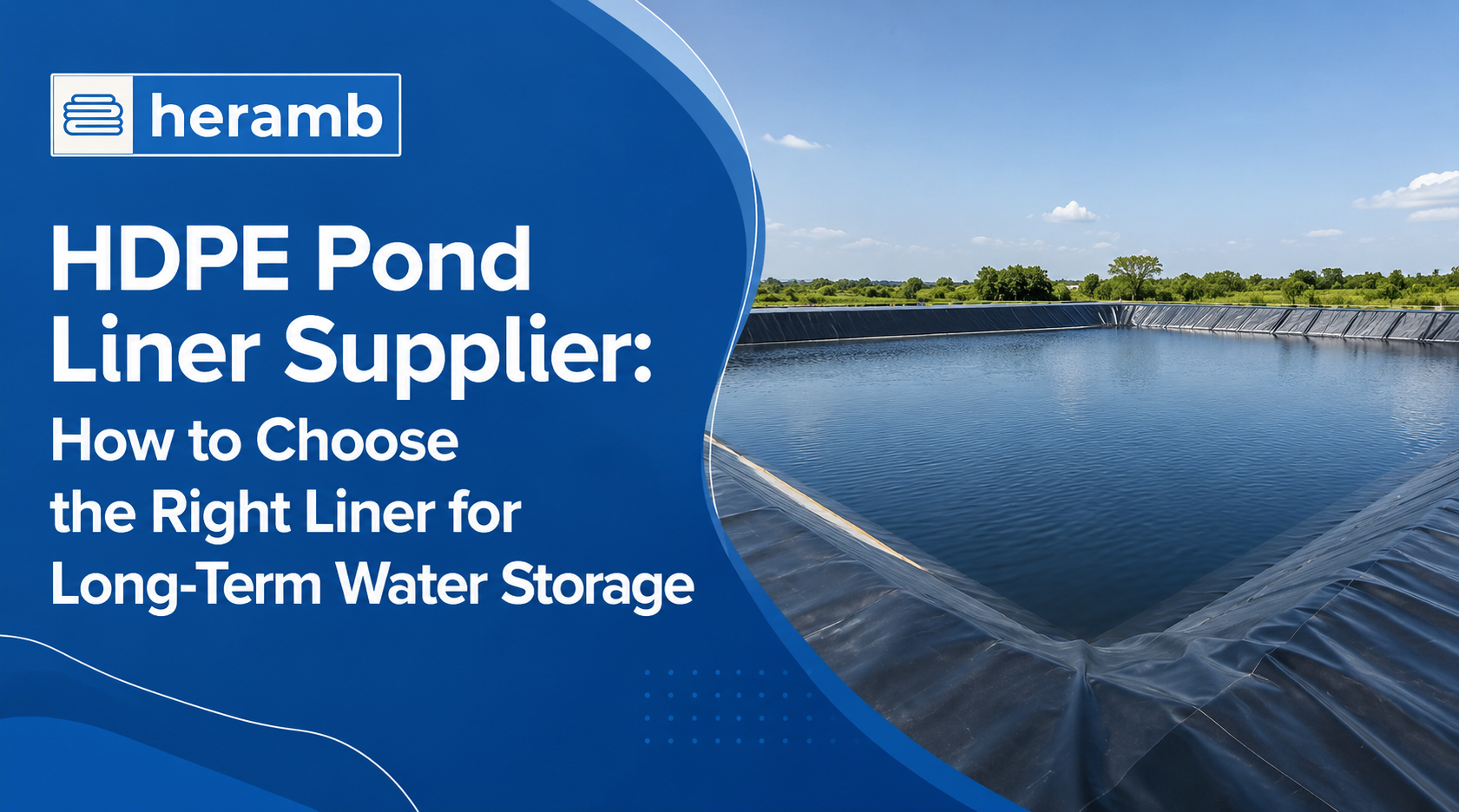
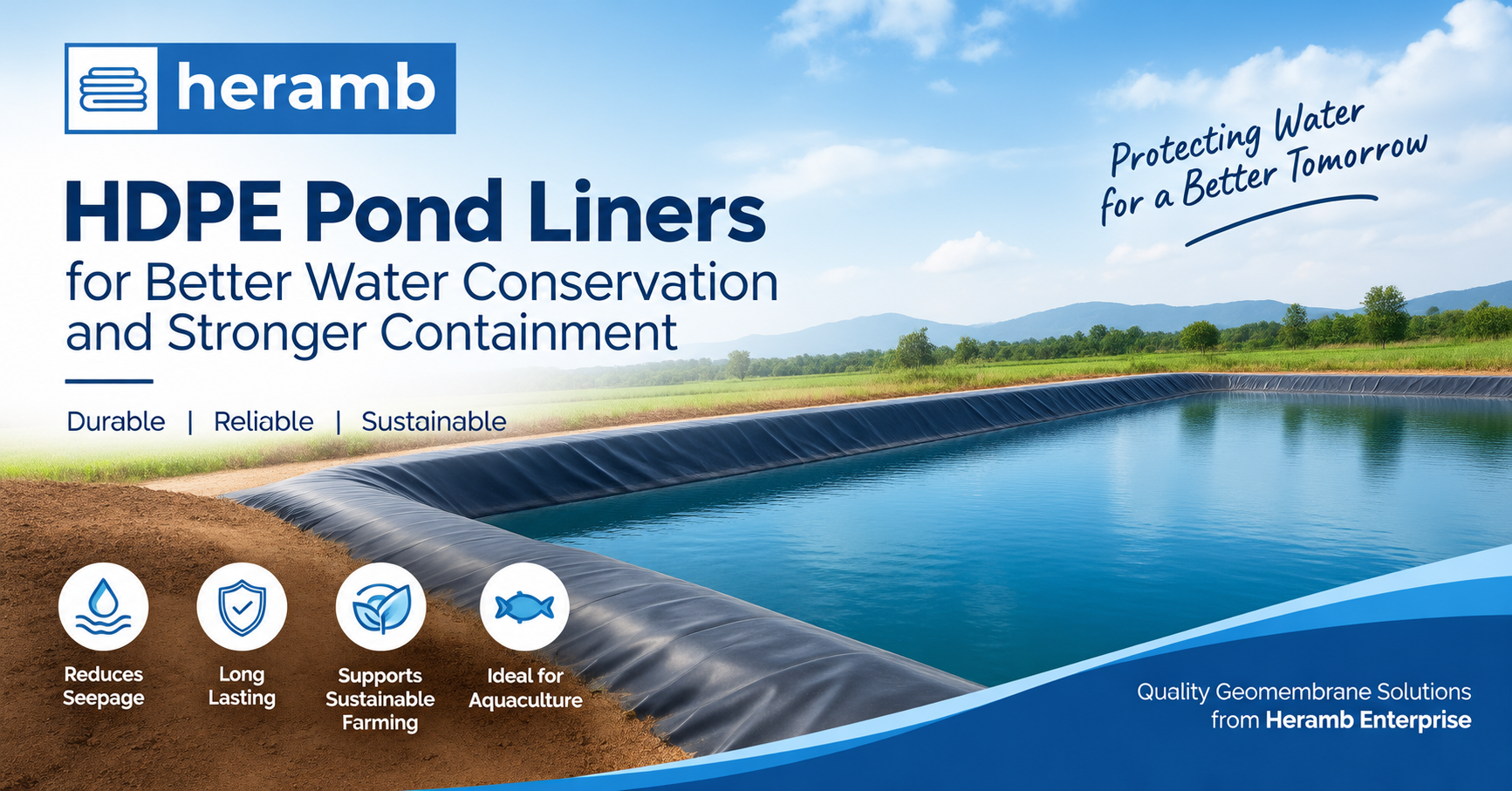

Storage becomes more efficient if the pond construction provides minimum water loss due to seepage and maintains proper containment of stored water. HDPE Pond Liners are used as lining material in ponds and water containment structures since they provide a durable geomembrane barrier between the stored water and surrounding soil.
Choosing the right liner in case of agricultural ponds, aquaculture facilities, rainwater harvesting, or any water storage facility is much more complicated than picking the cheapest one. Such criteria as pond size, soil conditions, installation technique, anticipated use, HDPE Pond Liner thickness, and even preparation of the site have to be taken into account.
An HDPE geomembrane liner can be placed above a properly prepared pond bottom to provide the low permeability lining layer. Heramb Enterprise proper selection and installation, it can assist in control of water loss via soil seepage.
What Are HDPE Pond Liners?
HDPE Pond Liners are a particular kind of sheet made from high-density polyethylene which is applied as a liner for ponds or any other container filled with water. The main goal of using HDPE Pond Liners is the creation of a low-permeable layer between water and the ground beneath it.
These liners can be applied in different areas – water storage for agricultural needs, aquaculture, rainwater collection, irrigation ponds, etc.
How Can HDPE Pond Liners Help in Water Conservation?
Water conservation is not limited to collecting it but also includes proper retention. Any soil-based ponds may face water losses due to seepage because of soil composition, groundwater, and pond construction.
Usage of HDPE Pond Liners in Water Conservation projects can help overcome seepage problems by adding continuous geomembrane lining layer.
The principle is pretty simple:
- The pond area is excavated and formed according to the project design.
- Subgrade preparation and clearance of sharp objects and other possible damaging materials are done.
- HDPE geomembrane is installed over the prepared surface.
- The adjacent sheets are joined using a specific welding technique.
- The installed geomembrane lining system is checked before pond commissioning.
It does not create water but improves its retention in the existing structure.
Applications of HDPE Pond Liners
An HDPE liner installation will depend on the function of the pond or project needs. Common applications include:
Water storage for agriculture purposes
This involves the storage of water in farm ponds to support irrigation and other agricultural uses. A well-designed liner helps reduce any seepage into the soils in surrounding areas.
Aquaculture or fish farming
This involves fish ponds where the construction and operation of ponds need careful planning. In such a case, a well-designed liner can act as a controlled barrier between the water in the pond and the ground.
Rainwater collection
A well-designed pond can collect rainwater for future use. Lining the pond can be considered when the soils are permeable causing substantial seepage issues.
Reservoirs for irrigation
Such ponds may be lined when used in infrastructure projects for storing water for irrigation purposes. The appropriate liner type is selected according to the needs of the project.
Industrial applications
These include a wide range of containment and lining applications. Further assessment is needed to establish the compatibility with chemicals involved.
What Makes HDPE Suitable for Pond Lining?
HDPE is a thermoplastic material which can be used in geomembranes. Various properties make it suitable for many lining projects.
Factors to consider include:
- Low permeability: This makes it easy to create a barrier against water movement through the lined surface.
- Durability: HDPE is durable since it can withstand harsh environments as long as it is appropriately designed and installed.
Weldability: Sheets of HDPE can be welded to form lining systems using thermal welding processes. - Flexibility: The material is flexible and can accommodate the design of a prepared pond surface.
Resistance to chemicals: HDPE has resistance to several chemicals though this should be confirmed for particular projects. - Suitability for outdoor: There exist HDPE grades which can be used in outdoor lining systems subject to project needs.
Performance of the material depends on the specification, site conditions, installation and operating environment.
What Should One Consider When Choosing an HDPE Liner?
One cannot choose any liner specification that will fit all the ponds because it should start by knowing the real requirement of the project.
Here are some considerations:
1. Size of the Pond
It is very important that one gets the length, width, depth and slopes accurately as there is always a need for extra material in overlapping, welding and securing.
2. Condition of the Soil and Subgrade Surface
One should ensure that the surface beneath the geomembrane is well-prepared because stones, roots, sharp objects and other irregularities may pose challenges.
3. Thickness of the Liner
The thickness of the liner depends on the application, subgrade conditions, mechanical stresses among others and therefore it doesn’t mean that thick liner is the best option for all projects.
4. Installation Procedures
When one wants to install geomembrane liners, he/she needs to take care of panel placement, seaming, edge anchoring and inspection. Poor installation will definitely ruin good materials.
5. Intended Use
Liner used in agricultural water pond has different characteristics from that one used in aquaculture or industrial applications.
HDPE Pond Liners vs. Unlined Ponds
| Factor | HDPE-Lined Pond | Unlined Pond |
| Water containment | Provides a low-permeability barrier | Depends significantly on natural soil conditions |
| Seepage control | Can reduce water movement into surrounding soil | May experience substantial seepage depending on soil |
| Surface preparation | Requires engineered preparation | Generally relies on natural or compacted soil |
| Installation | Requires panel placement and seaming | Does not require geomembrane installation |
| Design flexibility | Can be incorporated into engineered containment systems | Performance depends more heavily on site conditions |
Depending on the goals, soil composition, need for watering, budget and other engineering aspects, one can choose the right option.
What Are Common Mistakes When Installing Pond Liners?
Even the high-quality geomembrane will get damaged if not installed properly. Common mistakes include:
- Installation over an unsuitable subgrade
- Existence of sharp stones or roots under the liner
- Wrong installation of panels
- Poor seam joining
- Poor edge fixing
- Unnecessary dragging of the liner over harsh surfaces
- Neglecting of the site conditions and hydrostatic pressures
- Lack of inspection of seams and final liner system
Professional installation and appropriate quality control measures become especially relevant when installing liners for large-scale ponds.
How Can HDPE Pond Liners Assist in Managing Water?
It is necessary to take into account the fact that the pond liner system must be taken as part of the water management system.
Proper planning will ensure:
- Right geometry of the pond
- Right preparation of the subgrade
- Right selection of the liner
- Right seam joining
- Right fixing of the edges
- Physical damage protection
- Periodic visual inspection where it is possible
- Right maintenance
All these components provide good water containment.
Key Takeaways
- HDPE pond liners provide a layer with low permeability for water containment purposes.
- This solution can be used for agricultural ponds, aquaculture, harvesting of the rainwater and irrigation ponds.
- HDPE Pond Liners in Water Conservation applications may be helpful in solving the problem of seepage water losses.
- Right thickness and proper material should be selected according to real project conditions.
- Proper subgrade preparation and seam quality are integral parts of the installation process.
Long-term operation relies on material selection, installation and site conditions.
Frequently Asked Questions
1. What are the uses of HDPE pond liners?
HDPE pond liners are used in water storage, agriculture, aquaculture, irrigation ponds, and rainwater harvesting to minimize water seepage.
2. In what way do HDPE pond liners help in conserving water?
HDPE pond liners create a barrier against water seepage.
3. Is it advisable to use HDPE geomembrane pond liner in fish farming?
Yes, it is possible to use HDPE geomembrane pond liners for fish farming if the appropriate choice and installation of the liner are done.
4. How thick should the HDPE pond liner be?
It depends on the pond’s size, soil type, the installation procedure, and the use of the pond liner.
5. Is it advisable to use HDPE liners in agricultural ponds?
Yes, it is possible to use HDPE liners in agricultural ponds for storing water.
6. For how long does the HDPE pond liner last?
The lifespan of the liner depends on many factors.
Conclusion
HDPE Pond Liners offer a practical choice of materials that can be used in case when it is necessary to have controlled water containment and seepage management.
However, choosing a geomembrane should always include more parameters than just material selection. The dimensions of the pond, soil subgrade conditions, thickness of the liner, installation and the application should all be taken into account.
Heramb Enterprise offers a range of geomembrane solutions for various lining and containment projects. In order to recommend a proper HDPE geomembrane solution, it is necessary to analyze pond conditions and application needs.