
Most liner failures don’t happen because the material was weak, they happen because the wrong type of sheet was used on a slope. A smooth liner sitting on a steep landfill face or a mining embankment will eventually slide, wrinkle, or pull away from its anchor trench under sustained load. That’s the problem textured sheets were designed to solve, and it’s why so many engineers searching for a Textured HDPE Geomembrane Manufacturer in India are usually dealing with a project where slope angle and friction actually matter, not just a routine lining job.
This guide walks through what textured HDPE geomembrane really is, why it behaves so differently from smooth sheets on sloped ground and how thickness and specification choices change depending on whether you’re working on a landfill, a mine, or a waste containment structure. We’ll also touch on how Heramb Geomembrane approaches this from manufacturing consistency to site-specific recommendations so you come away with something you can actually use, not just another product pitch.
What Is Textured HDPE Geomembrane?
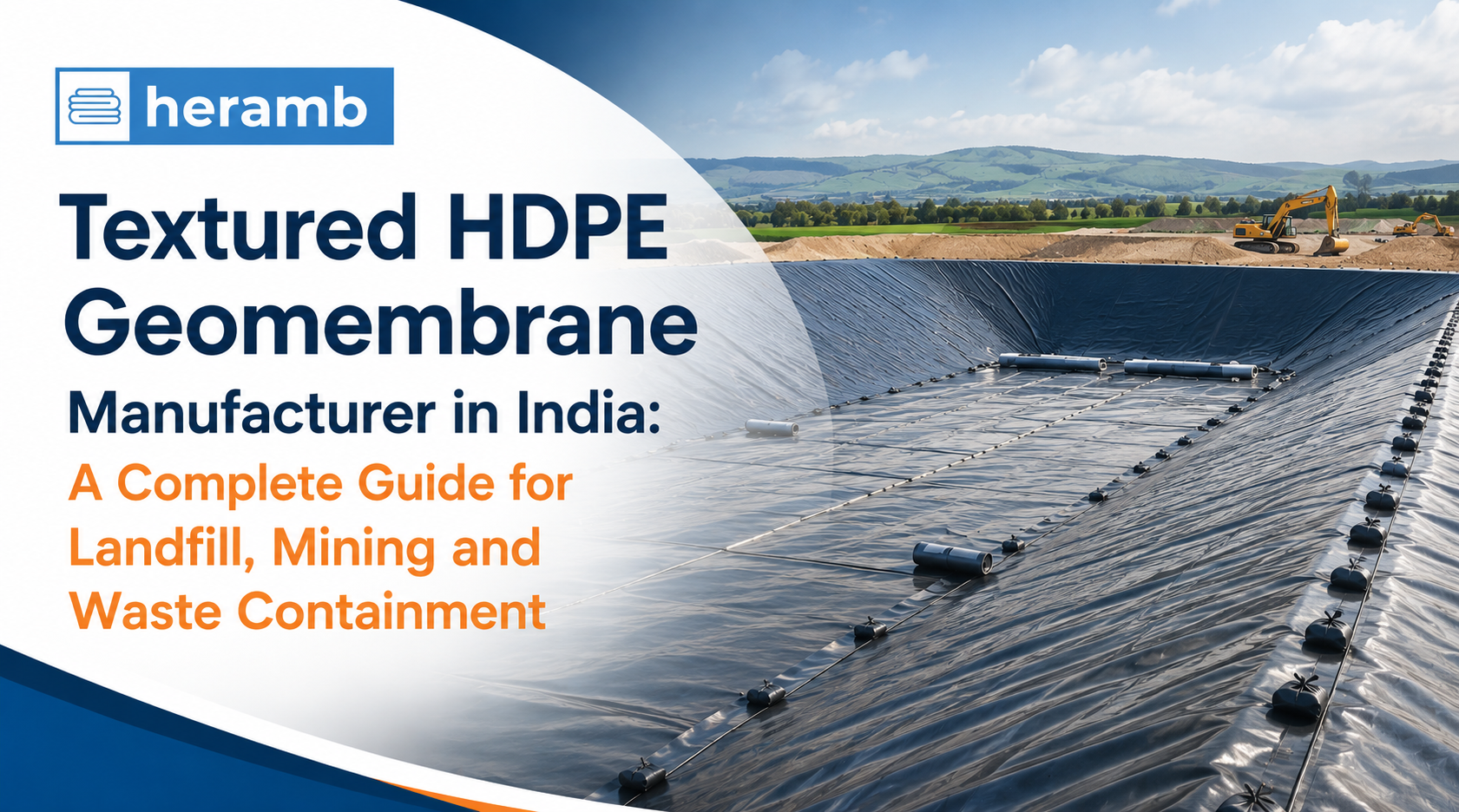
Textured HDPE geomembrane is a high-density polyethylene sheet that’s given a deliberately roughened surface during extrusion, instead of the smooth, almost glossy finish you’d see on standard HDPE liners. That rough surface isn’t cosmetic, it increases the actual contact area between the geomembrane and whatever sits against it, whether that’s compacted soil, a geotextile layer, drainage stone, or waste material.
The practical effect is a much higher coefficient of friction at the interface. On flat ground, this barely matters. On a slope, it’s the difference between a liner that stays put for decades and one that creeps downward the moment load builds up above it which is exactly why textured sheets are the default choice for landfill side slopes and most mining containment structures.
How Texturing Differs from Smooth HDPE Geomembrane
Smooth HDPE works well where there’s no slope to fight, pond liners, canal lining, flat-bottomed water storage. There’s no meaningful shear force pulling the sheet in one direction, so friction isn’t the deciding factor.
Textured geomembrane earns its keep on:
- Steep or moderately sloped surfaces where shear stress accumulates over time
- Sites where waste, cover soil, or drainage layers rest directly on the liner
- Projects where interface shear strength has to meet a specific engineering or regulatory threshold
Get this choice wrong, say, a smooth sheet on a slope that should have been textured and you’re looking at liner displacement, wrinkling, or in the worst case, a genuine structural failure of the containment system.
Why Landfill Projects Depend on Textured Geomembrane
Landfills ask a lot of a liner. Chemical exposure from leachate, constant mechanical loading from compaction and cover soil, and slope geometry all come together in one system, and none of them are forgiving.
Preventing Leachate Migration on Slopes
Landfill cells are almost never flat by design, side slopes are angled to squeeze more capacity out of a site. That’s precisely where friction becomes non-negotiable. Without enough of it, the geomembrane can slide downward under the accumulated weight of waste and cover soil, which puts the entire leachate containment system at risk and opens the door to groundwater contamination.
Regulatory and Engineering Requirements
Landfill design across India is increasingly aligned with international norms around interface shear strength testing, especially for municipal solid waste and hazardous waste sites. In practice, textured HDPE geomembrane for landfill side slopes tends to fall in the 1.5 mm to 2.5 mm range, with the exact figure driven by waste depth, slope angle, and whatever local regulatory guidelines apply.
Common Landfill Applications for Textured Liners
- Municipal solid waste landfill side slopes
- Hazardous waste containment cells
- Support for leachate collection and drainage layers
- Final cover systems on capped landfill slopes
Why Mining Projects Require Textured HDPE Geomembrane
Mining sites are arguably tougher on a liner than almost any other application, aggressive leaching chemicals, constant heavy equipment traffic, steep slope angles, and a design life that often stretches into decades.
Heap Leach Pad Stability
In heap leach mining, ore gets stacked on a lined pad, and a leaching solution is applied over the top to draw out valuable minerals as it percolates down. The liner underneath has to hold up against the chemical solution and the sheer mechanical weight of stacked ore, all while sitting on sloped ground. Any manufacturer supplying a mining operation as a Textured HDPE Geomembrane Manufacturer in India needs to understand this exact combination of chemical and mechanical stress, not just sell a generic liner.
Tailings Containment and Slope Reinforcement
Tailings storage facilities lean on textured liners just as heavily, particularly along embankment slopes where tailings and process water push against the liner continuously. That added friction lowers the risk of slippage and given that these facilities are often designed to last for decades, there’s very little margin for a liner that underperforms over time.
Key Mining Applications
- Heap leach pads
- Tailings storage facility slopes
- Process water containment ponds with sloped sections
- Waste rock dump liners
Waste Containment Systems Beyond Landfills
Textured geomembrane’s job isn’t confined to landfills and mines, it shows up throughout industrial and municipal waste infrastructure wherever slopes are involved.
Industrial and Hazardous Waste Facilities
Chemical storage impoundments, fly ash ponds and industrial effluent containment systems frequently include sloped sections, and textured liners are what keep them from shifting as load conditions fluctuate. The combination of chemical resistance and mechanical stability is exactly why HDPE dominates this category.
Effluent and Sewage Treatment Support
Treatment plant tanks themselves are usually flat-bottomed, but the embankments, buffer zones and sloped berms surrounding them still benefit from textured liners, for the same friction-related reasons that apply to landfills.
Key Properties to Evaluate in Textured HDPE Geomembrane
When you’re comparing suppliers, price per square meter shouldn’t be the first thing you look at. These properties matter more:
Friction and Interface Shear Strength
This is really the whole point of a textured geomembrane. Deeper texture, higher asperity height, generally means better friction performance, but that’s a generalization, not a guarantee. Always validate against project-specific interface shear testing rather than taking it on faith.
Chemical and UV Resistance
Landfill leachate and mining process solutions can be genuinely aggressive chemically. A liner worth using has to resist degradation from that exposure over its full service life, and UV stabilization protects any exposed sections from breaking down under sunlight during installation and operation.
Puncture and Tensile Strength
Waste sites come with rough subgrades, heavy machinery and sharp debris almost as a rule. Puncture resistance is what determines whether the liner survives installation intact and holds up under long-term loading without developing leak points.
Thickness Selection
Textured HDPE geomembrane commonly comes in 1 mm, 1.5 mm, 2 mm, and 2.5 mm thicknesses. Thinner sheets can work for lower-risk, shorter-duration projects, but landfill and hazardous waste applications usually call for something in the 1.5 mm to 2.5 mm range depending on load, slope, and regulatory requirements.
How to Choose the Right Textured HDPE Geomembrane Manufacturer in India
Sourcing for a project this technical takes more diligence than a typical purchase decision. A few things worth checking:
Manufacturing Quality Control
Consistent thickness, even texture distribution and resin quality all directly affect how the liner performs in the field. Ask for test certificates and quality documentation before you finalize an order, don’t take it on the supplier’s word alone.
Application-Specific Guidance
A supplier worth working with doesn’t just move sheets, they help match thickness, texture pattern and specification to your actual slope angle, waste type, and regulatory requirements. This is where Heramb Geomembrane tends to work closely with project engineers, aligning the product to real site conditions instead of pushing one liner as a fit for everything.
Certification and Standards Compliance
Look for ISO-certified manufacturing and products that have been tested against recognized geomembrane performance standards, this matters even more for regulated applications like hazardous waste containment.
Delivery and Installation Support
Landfill and mining projects tend to run on tight construction timelines. A manufacturer that delivers reliably and offers real technical support during installation saves you from delays that are expensive to absorb later.
Installation Considerations for Textured Liners on Slopes
Even a well-made liner underperforms if it’s installed carelessly. A few things worth keeping in mind on site:
- Subgrade needs to be properly compacted and cleared of sharp debris before the liner goes down
- Anchor trenches at the top of slopes should be engineered to hold the liner firmly against downslope forces
- Seam welding on textured sheets takes an experienced hand, the surface texture can affect weld quality if the technician isn’t used to working with it
- Temperature and weather during installation change how the material behaves, especially during welding
FAQ Section
What makes textured HDPE geomembrane different from smooth HDPE geomembrane?
Textured geomembrane has a roughened surface added during manufacturing that increases interface friction, making it the right choice for sloped applications. Smooth geomembrane works better on flat-bottom containment like ponds and reservoirs, where friction isn’t the deciding factor.
What thickness of textured HDPE geomembrane is used for landfill slopes?
Landfill side slopes generally use textured liners between 1.5 mm and 2.5 mm. The exact thickness depends on slope angle, waste depth, and the local regulatory requirements that apply to the site.
Is textured HDPE geomembrane suitable for mining heap leach pads?
Yes. Textured liners are the standard choice for heap leach pads because they provide the friction needed to keep the liner stable under stacked ore and continuous leaching solution on sloped ground.
How does texture improve slope stability?
The roughened surface raises the coefficient of friction between the liner and whatever sits against it, soil, geotextile, or waste, which reduces the chance of the liner sliding under gravity and sustained load.
Does installation affect the performance of textured geomembrane?
It does, more than people expect. Proper subgrade preparation, correctly engineered anchor trenches, and experienced seam welding are all essential poor installation practices that can undermine even a high-quality liner.
Conclusion
Textured HDPE geomembrane exists for one clear reason, to keep containment systems stable on slopes where a smooth liner would eventually give way. Whether the project is a landfill side slope, a heap leach pad, or an industrial containment berm, the friction properties, chemical resistance, and thickness you choose will quietly decide how well the system holds up over its entire design life.
As a Textured HDPE Geomembrane Manufacturer in India, Heramb Geomembrane pairs quality-tested material with practical, site-specific guidance to help engineers get containment right the first time, not the second. If you have a landfill, mining, or waste containment project on the table, reach out to Heramb Geomembrane for a free quote and a recommendation built around your actual site conditions, not a generic spec sheet.