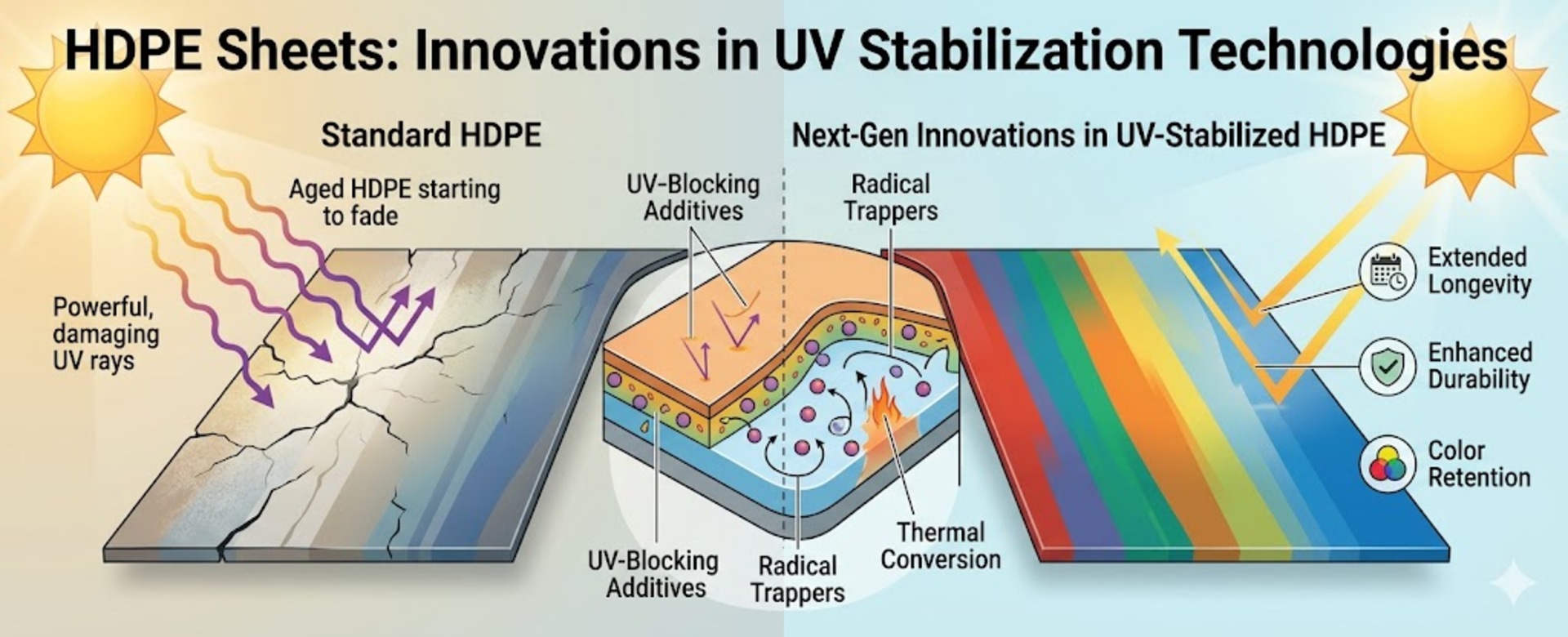

Exposure to ultraviolet (UV) radiation can degrade plastic materials over time, causing cracking, brittleness, and loss of strength. Innovations in UV stabilization technologies have enhanced the performance of HDPE sheets in outdoor applications, ensuring durability and longevity even in harsh environments.
Advancements in UV Stabilization Technologies for HDPE Sheets:
- Carbon Black Additives:
- One of the most effective UV stabilizers for HDPE sheets, carbon black absorbs UV radiation and prevents it from penetrating the material.
- Applications: Landfill liners, pond liners, and agricultural films.
- Benefit: Provides long-term resistance to UV damage.
- UV Absorbers:
- Advanced UV absorbers are integrated into HDPE formulations to capture and dissipate UV radiation as heat.
- Applications: Outdoor storage tanks, irrigation canals, and roofing systems.
- Benefit: Minimizes material degradation and color fading.
- Hindered Amine Light Stabilizers (HALS):
- HALS additives work by scavenging free radicals generated by UV exposure, preventing the breakdown of the HDPE polymer.
- Applications: HDPE geomembranes for outdoor applications.
- Benefit: Extends the material’s service life while maintaining flexibility.
- Co-Extruded UV-Stabilized Layers:
- HDPE sheets can be manufactured with a co-extruded outer layer containing UV stabilizers, providing targeted protection without altering the core material.
- Applications: Roofing membranes and greenhouse covers.
- Benefit: Cost-effective and highly durable solution.
- Nanotechnology-Based Stabilizers:
- Nanomaterials are being explored for their potential to enhance UV resistance in HDPE sheets by improving the dispersion and efficiency of stabilizers.
- Applications: Advanced geomembranes and high-performance outdoor liners.
- Benefit: Increased durability with minimal environmental impact.
By leveraging these UV stabilization technologies, HDPE sheets can perform reliably in prolonged outdoor exposure, ensuring their effectiveness in critical applications.