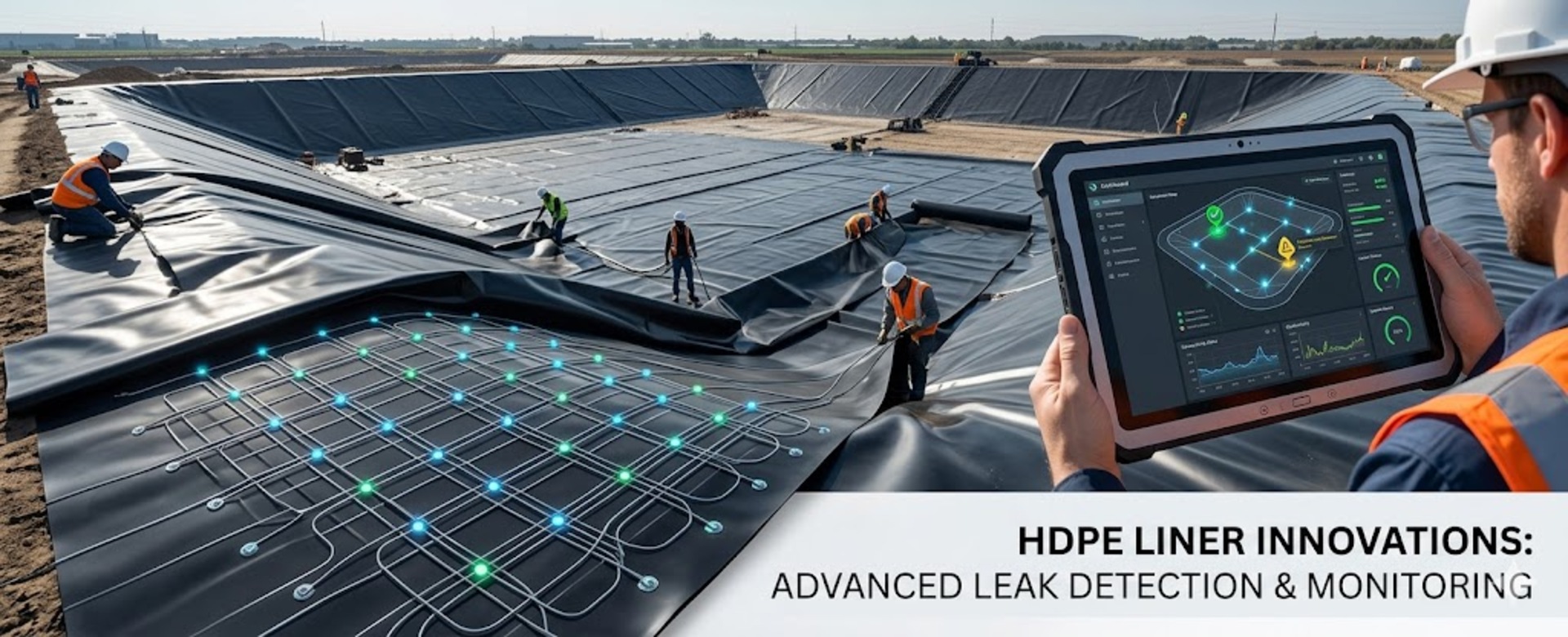

Leak detection and monitoring are essential in applications where HDPE sheets are used to contain hazardous materials, manage water systems, or prevent contamination. Innovations in leak detection technology have greatly enhanced the ability to identify and address leaks in HDPE sheets, ensuring greater reliability and environmental protection.
Innovative Leak Detection Methods for HDPE Sheets:
- Electrical Leak Location (ELL) Technology:
- ELL is one of the most effective methods for detecting leaks in HDPE sheets. It works by applying an electric current across the geomembrane’s surface. When a leak is present, the current escapes through the puncture, allowing its exact location to be identified.
- Applications: Landfills, wastewater treatment ponds, and chemical containment systems.
- Benefits: Pinpoint accuracy, non-destructive testing, and rapid results.
- Fiber Optic Sensing:
- Fiber optic sensors are embedded in or placed beneath HDPE sheets to monitor changes in temperature, pressure, or strain. Any anomalies caused by a leak are detected in real-time, enabling immediate action.
- Applications: Critical containment systems, such as hazardous waste storage or mining operations.
- Benefits: Continuous monitoring and real-time alerts.
- Vacuum Box Testing:
- Vacuum box testing involves creating a vacuum over the geomembrane’s seam to detect leaks. Bubbles form if air escapes through a puncture or improper seam weld.
- Applications: Verification of seam integrity during installation.
- Benefits: Simple, effective for quality assurance.
- Thermal Imaging and Infrared Scanning:
- Infrared cameras detect temperature variations caused by leaks in the HDPE sheet. Leaking water or chemicals often create distinct thermal signatures, making leaks visible in thermal images.
- Applications: Reservoirs, large-scale geomembrane installations.
- Benefits: Ideal for large areas and remote inspections.
- Acoustic Leak Detection:
- Acoustic sensors detect sound waves generated by leaks in pressurized systems or liquid flows. This method is particularly useful for detecting leaks in HDPE-lined pipes or channels.
- Applications: Water pipelines, drainage systems.
- Benefits: Non-invasive and highly sensitive.
By incorporating these innovative technologies, industries can significantly improve the effectiveness of leak detection and monitoring in HDPE sheet systems, reducing environmental risks and operational costs.