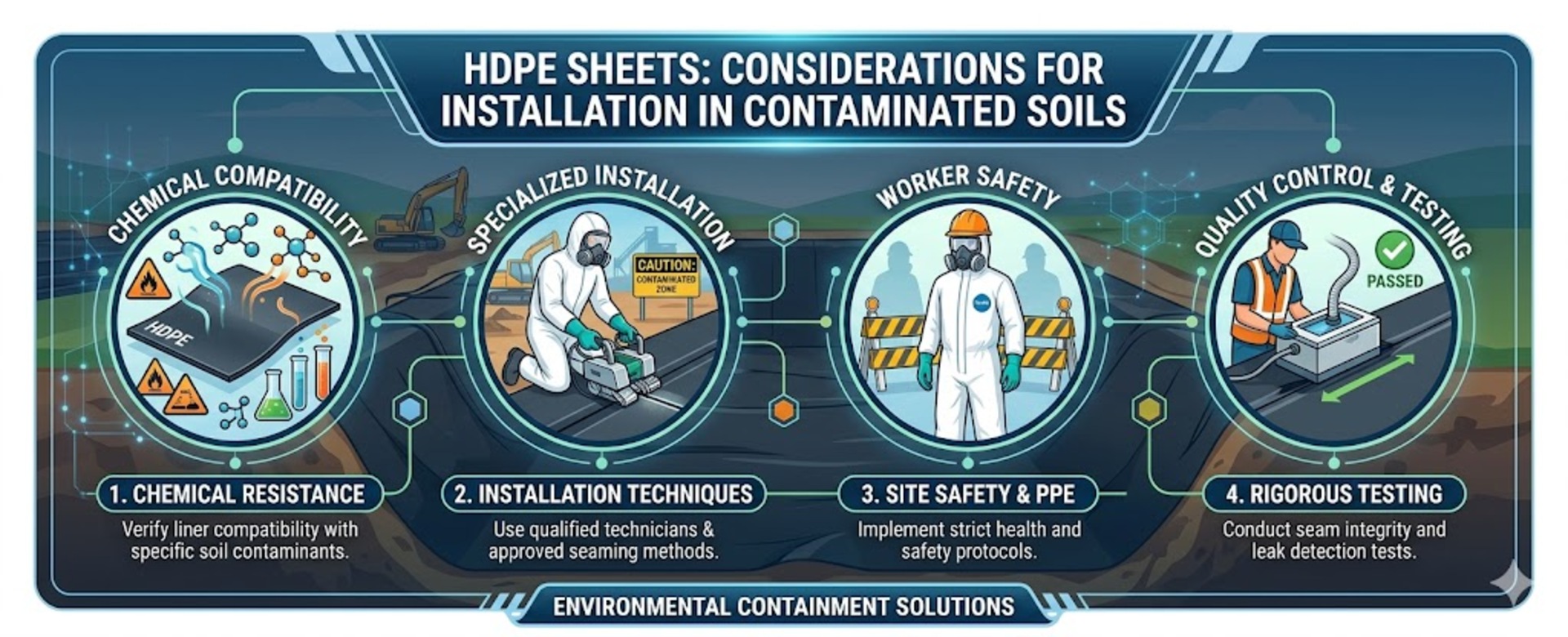

Installing High-Density Polyethylene (HDPE) sheets in contaminated soils requires specialized planning and execution to ensure containment and prevent further environmental damage. These sheets act as a protective barrier, isolating contaminants and preventing their migration into groundwater or surrounding ecosystems.
Key Considerations for Installation in Contaminated Soils:
- Thorough Site Assessment:
- Conduct a detailed analysis of the contaminated site to determine the nature and extent of contamination. Assess soil composition, contaminants, and potential risks.
- Tip: Use geotechnical surveys and soil testing to guide the installation process.
- Surface Preparation:
- Remove sharp objects, debris, and irregularities from the soil surface to prevent punctures in the HDPE sheet. For heavily contaminated soils, consider adding a geotextile layer beneath the geomembrane for additional protection.
- Tip: Ensure the subgrade is compacted and leveled for a smooth installation.
- Chemical Compatibility:
- Select an HDPE sheet with chemical resistance suitable for the contaminants present. Different grades of HDPE are designed to withstand specific chemicals, such as hydrocarbons, acids, or alkalis.
- Tip: Consult chemical resistance charts to ensure compatibility.
- Secure Seaming and Welding:
- Proper seam welding is critical for preventing leaks in contaminated environments. Use high-quality welding techniques, such as extrusion welding, and conduct non-destructive testing to verify seam integrity.
- Tip: Perform seam testing after installation to ensure leak-proof joints.
- Drainage and Leachate Collection Systems:
- Install a drainage layer or leachate collection system above or below the HDPE sheet to manage any liquid generated by the contaminated soil.
- Tip: Incorporate perforated pipes or drainage geocomposites to collect and direct leachate safely.
By addressing these considerations, HDPE sheets can provide reliable and long-term containment solutions in contaminated soil environments.