
Installing HDPE geomembrane sheets requires precision and expertise to ensure effective containment and long-term performance. Recent innovations in installation techniques have improved efficiency, reduced costs, and enhanced the reliability of geomembrane systems.
Innovative Installation Techniques:
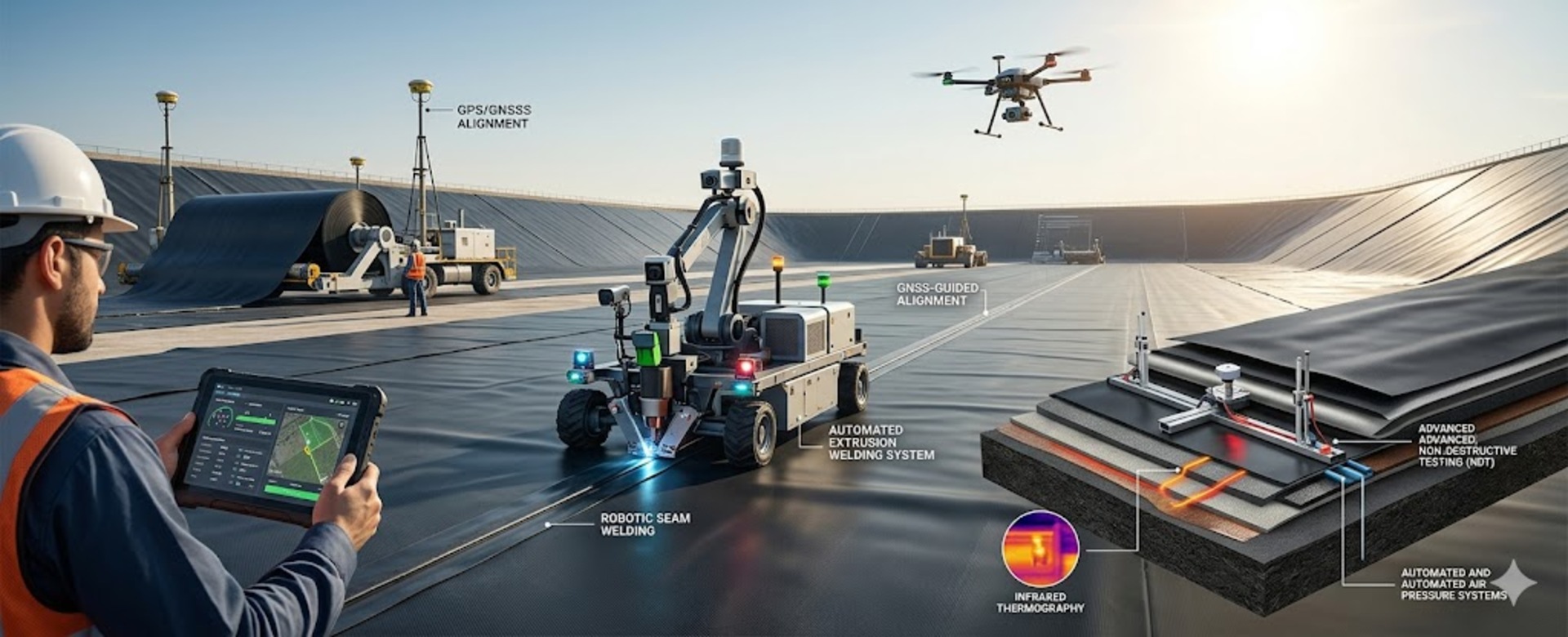
- Automated Welding Systems:
- Automated seam welding machines ensure consistent, high-quality seam bonds with minimal human error.
- Benefit: Reduces installation time and improves seam strength.
- Advanced Leak Detection Technologies:
- Electric leak location (ELL) systems are integrated during installation to identify and address potential leaks in real-time.
- Benefit: Ensures a leak-proof system and minimizes post-installation repairs.
- Prefabricated Panels:
- Large geomembrane panels are fabricated off-site and transported for on-site deployment, reducing seaming requirements.
- Benefit: Speeds up installation and improves overall system integrity.
- Self-Adhesive Liners:
- Some HDPE sheets now feature self-adhesive properties, simplifying installation on complex surfaces or vertical walls.
- Benefit: Reduces the need for additional adhesives or welding in certain applications.
- Drones for Site Assessments:
- Drones equipped with thermal or visual imaging assist in pre-installation surveys and post-installation inspections, ensuring site readiness and seam quality.
- Benefit: Enhances accuracy and reduces labor costs.
- Dual-Seam Welding Techniques:
- Dual-track welding creates two parallel seams with an air channel in between, enabling pressure testing for leak detection.
- Benefit: Provides superior seam integrity and ensures long-term performance.
- Textured Liners for Sloped Installations:
- Textured HDPE sheets improve friction and stability on steep slopes, reducing the risk of liner slippage.
- Benefit: Enhances safety and performance in challenging terrains.
These innovations have streamlined the installation process, making HDPE geomembrane systems more efficient, reliable, and cost-effective.