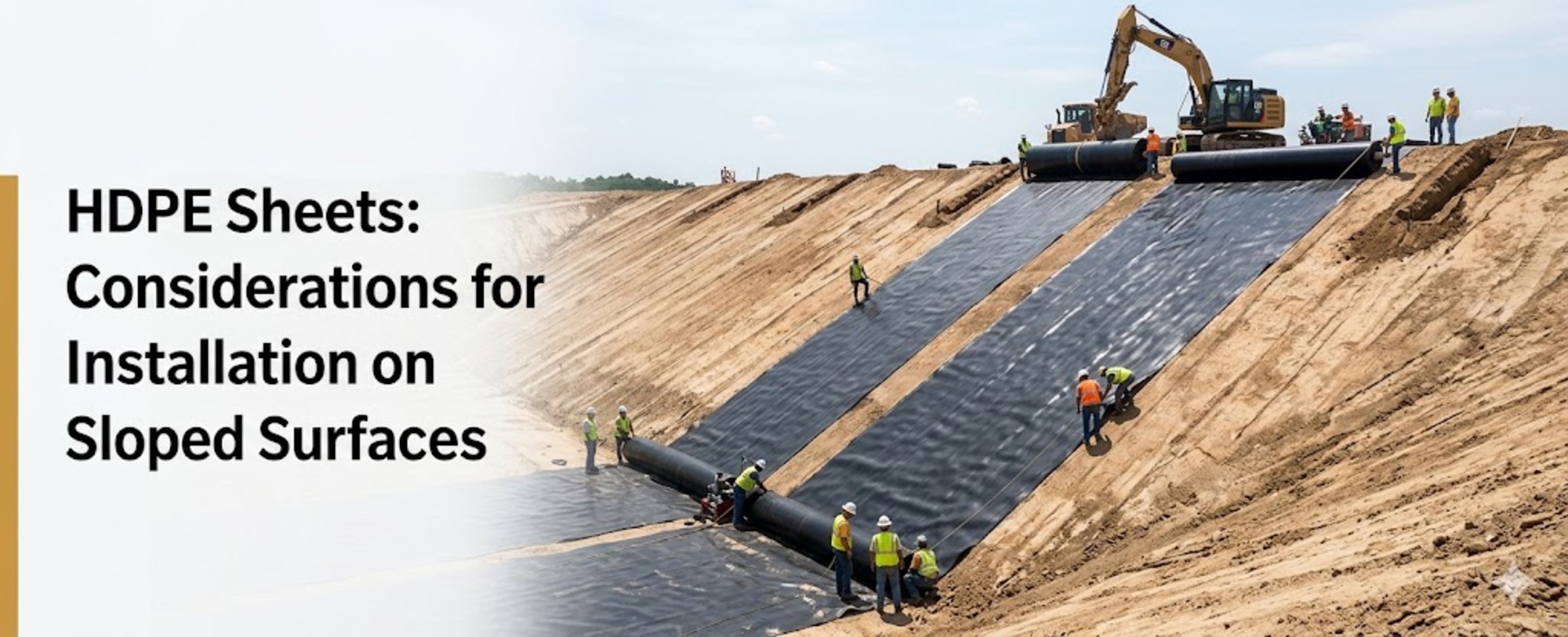

Installing HDPE sheets on sloped surfaces requires careful planning and specialized techniques to ensure stability, durability, and effectiveness. Sloped installations are common in applications such as landfill liners, embankment protection, and water reservoirs, where the geomembrane must resist sliding, tearing, and deformation.
Key Considerations for Installing HDPE Sheets on Sloped Surfaces:
- Surface Preparation:
- Ensure the slope is free of sharp objects, debris, and irregularities that could puncture or damage the HDPE sheet. A smooth, compacted subgrade or a cushioning layer (e.g., geotextile fabric) can help protect the geomembrane.
- Tip: Proper surface preparation minimizes stress points and extends the lifespan of the HDPE sheet.
- Anchor Trench Installation:
- Anchor trenches are used at the top and bottom of slopes to secure the geomembrane and prevent it from sliding. Trenches should be properly designed and filled with compacted soil or concrete to hold the HDPE sheet in place.
- Tip: Ensure the anchor trench depth and width are adequate to handle expected tensile forces.
- Tension Management:
- HDPE sheets must be installed with proper tension to prevent wrinkling or sagging. Excess tension can lead to tearing, while insufficient tension can cause uneven surfaces that compromise performance.
- Tip: Avoid installing sheets during extreme temperature fluctuations to prevent thermal expansion or contraction issues.
- Seaming and Welding:
- Seams should be welded parallel to the slope to minimize stress on the joints. Use high-quality welding techniques, such as extrusion or thermal fusion welding, to ensure strong, leak-proof seams.
- Tip: Conduct non-destructive seam testing to verify seam integrity before finalizing the installation.
- Ballast and Protection Layers:
- To prevent the HDPE sheet from lifting due to wind or water pressure, ballast materials such as sandbags, gravel, or protective covers are often used. These layers also provide additional protection against UV exposure and mechanical damage.
- Tip: Select ballast materials that are compatible with the specific project requirements.
- Slope Stability Analysis:
- Conduct a detailed analysis of the slope’s angle, soil conditions, and load-bearing capacity to ensure the HDPE sheet can withstand environmental stresses and maintain its position.
- Tip: For steeper slopes, consider using textured HDPE sheets to improve friction and stability.
By addressing these considerations, one can install HDPE sheets effectively on sloped surfaces, providing reliable performance and long-term stability.